

By 2026, the global smart wearable market had become a crowded battlefield, with fitness bands and smartwatches tracking everything from steps to sleep, and even handling calls, messages, and mobile payments as standard features. Yet, amid the trend toward larger screens and constant interaction, one brand dared to go against the grain. Its device has no screen at all, yet it has won over some of the most elite athletes on the planet—LeBron James, Cristiano Ronaldo, Michael Phelps—all of whom are devoted fans.
That brand is Whoop.
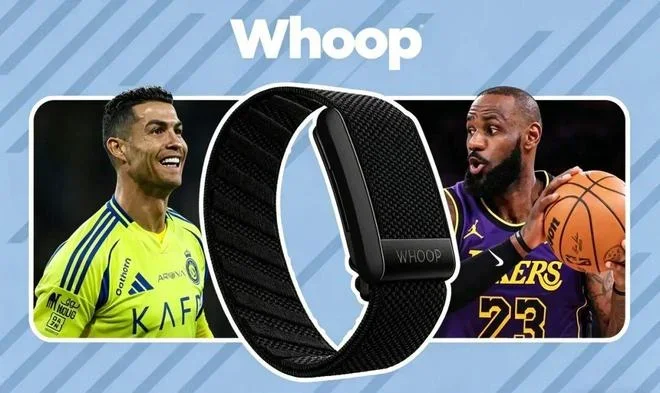
Recently, Whoop closed a $5.75 billion Series G funding round, pushing its valuation to an eye-popping $101 billion. Notably, the round attracted not only top-tier venture capital and healthcare giant Abbott but also a rare gathering of sports icons spanning basketball, soccer, and golf.
The roots of this business story trace back 14 years, to a 22-year-old Harvard squash team captain’s anxiety and a little-known academic paper.

It was 2012 in Cambridge, Massachusetts. Will Ahmed, then captain of Harvard’s men’s squash team, seemed to have it all: an Ivy League pedigree, elite athleticism, and the grit of his Egyptian heritage. But in his own eyes, he was simply lost when it came to understanding his body. He was caught in a vicious cycle: training hard to improve, getting injured from lack of recovery, then overtraining again to catch up, only to suffer worse injuries. During one match, his opponent’s drop shots left him collapsed on the court—not from exhaustion, but because his body had simply given up.
“I realized I knew nothing about my body,” Ahmed later recalled.
He saw that athletes—and regular people—didn’t lack the will to exercise; they lacked scientific data to know when to push and when to rest. So the history major dove into physiology, medicine, and engineering literature. He pored over more than 300 academic papers at Harvard’s library and interviewed cardiologists and physiologists. Just before graduation, he compiled his findings into a paper exploring how continuous physiological monitoring could enhance human performance.
That paper became the blueprint for Whoop’s business plan and the core algorithm behind its technology.
Armed with this thesis, Ahmed approached classmate John Capodilupo, a math and statistics prodigy. Pointing to the mathematical model in his paper, Ahmed asked, “Can you build this?” With a yes, the two set out from Harvard’s Innovation Lab to found Whoop (initially named Bobo Analytics).
At that time, most wearables could only count steps and estimate calories. In the future, devices might gain screens for calls, messages, and apps. But Ahmed defied common sense from the start: he decided to build a device with no screen, focused purely on sensing. He believed screens were a distraction. True health monitoring should be invisible—as comfortable as clothing, as professional as a personal doctor, not demanding you raise your wrist to check time or reply to messages. This counterintuitive minimalist design seemed suicidal to many, but it laid the foundation for Whoop’s later success.
Whoop’s breakthrough into public consciousness came largely through endorsement from top athletes. The most dramatic moment occurred at the 2026 Australian Open, known for its strict rules. Tournament officials targeted Whoop wristbands worn by players, ordering stars like Carlos Alcaraz, Jannik Sinner, and Aryna Sabalenka to remove them or not play. The ban sparked a firestorm. Players were furious, as they relied on the device to monitor physical load during matches. Whoop later clarified that the device has no communication or GPS functions and does not affect fair play.
Though the ban stood, the controversy thrust Whoop into the global spotlight. Sports fans everywhere asked, “What is that thing, and why can’t tennis stars live without it?”
In truth, this was part of Whoop’s strategy. Data shows that Whoop’s first 100 users were almost all world-class athletes. The list included two huge names: LeBron James and Michael Phelps.
Ahmed’s method of acquiring those first users was clever. Without money for advertising, he used a penetration strategy: he approached private trainers, physical therapists, and strength coaches who worked with elite athletes. For these professionals, Whoop’s data on heart rate variability (HRV), resting heart rate, and sleep cycles were crucial for designing training programs. Coaches recommended it to athletes, athletes started comparing data, and Whoop spread from the NFL to the NBA.
Today, Whoop’s endorsers read like a list of candidates for “Greatest of All Time” across sports: Formula 1 drivers, world golf number one Rory McIlroy, free solo climber Alex Honnold, and social media king Cristiano Ronaldo. The marketing logic is simple and effective: If you want to know how to push human limits, look at what those already pushing limits are using.
When a casual fitness enthusiast sees Ronaldo sleeping with a Whoop or James wearing it during playoff preparation, subconscious trust grows: “If they use it, the data must be real.”
But celebrity endorsements alone don’t justify a $101 billion valuation. Whoop’s real game-changer is its bold—some might say arrogant—business model.
Conventional wisdom says hardware is a one-time sale: you buy a watch, the company gets a hardware profit. Whoop does the opposite: it doesn’t even want you to “buy” the band. On its website, the strap wrapped around your wrist is free. Users pay a subscription fee, choosing different tiers and paying annually.
In 2018, Whoop took the risky step of shifting entirely from selling hardware to pure subscription. Wall Street analysts thought it was insane, because the company would have to constantly prove its value or risk losing subscribers.
But Ahmed insisted, “Understanding your body is a continuous daily investigation, not a one-time transaction.”
After the pandemic, global consumer health consciousness shifted. People no longer wanted just to treat illness; they wanted to prevent it. One of Whoop’s earliest studies used algorithms to predict COVID infection before symptoms appeared, transforming it from an athlete’s toy into a medical-grade tool. Its latest feature, “Healthspan,” claims to tell users how to live longer and healthier, hitting the deepest anxieties of the middle class.
While most fitness apps push you to challenge limits and compete with yourself, Whoop’s most famous function is telling users not to train. If data shows insufficient recovery, the app suggests resting. This unique “anti-training” feature builds deep trust by being scientifically sound.
Through the subscription model, Whoop created a stable cash flow moat. The market logic is simple: selling hardware is like running a factory; providing health management as a service is like a SaaS company. That’s why Whoop commands such a high price-to-sales ratio and attracted a healthcare giant like Abbott—because Whoop possesses massive, continuous physiological data from healthy individuals to elite athletes, a goldmine in the age of big health and AI drug discovery.
Whoop’s $101 billion valuation might seem inflated if only viewed through the lens of fitness