

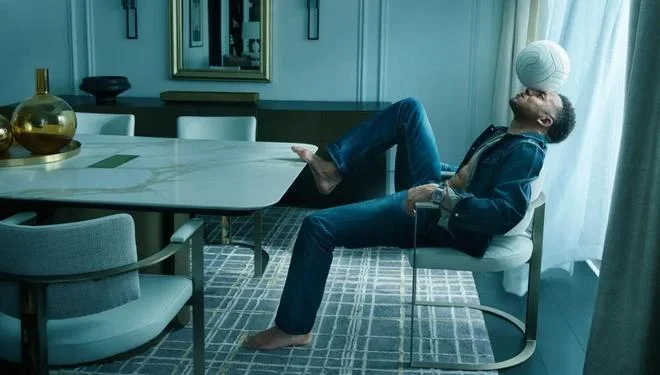
Kylian Mbappé graced the cover of Vanity Fair magazine’s latest issue. During a recent international break, the Real Madrid and France forward sat down for an in-depth interview, speaking openly about his views on football, his role in society, how he handles fame, and the upcoming World Cup. The conversation was extensive, and this is the second of three parts.
A generational talent with remarkable achievements, Mbappé has been a star from a young age while maintaining charisma and maturity. However, criticism has never been far behind. Some accuse him of being selfish on the pitch and quick to complain when things don’t go his way. This controversy has followed him throughout his career—even during his early days at Monaco’s youth academy, he was criticized for not tracking back enough in defense.
Now at Real Madrid, some fans and the notoriously demanding local press view him as an aloof presence within the squad. On the international stage, every move he makes is scrutinized under a microscope. In a recent friendly, a clip of him taking the captain’s armband from the beloved N’Golo Kanté went viral. Incidents like this have fueled the “dictator Mbappé” meme, painting the France captain as an authoritarian figure who dominates the team, sidelines teammates, and wields an iron fist.
“Some people might find him a bit arrogant at times,” said one observer. “But to me, he’s just a natural winner, completely confident in his abilities.” Another commentator agreed: “There’s an innate calmness about him, as if he belongs at the highest level.”
Driving from Charles de Gaulle Airport into Paris, a massive mural of Mbappé stands beside the highway in Bondy, the Seine-Saint-Denis suburb where he grew up. This area is known for producing many French football stars and is also one of the poorest parts of the country.
Thanks to his family’s support, Mbappé had a stable childhood surrounded by sports. His mother, Fayza, from an Algerian immigrant family, was a professional handball player. His father, Wilfried, a Cameroonian immigrant, coached at the local Bondy football club. They lived in a modest apartment across from the stadium, and even as a baby, Mbappé would follow his father around with a football.
From the start, his only goal was a professional football career. “Wherever he was, he just wanted to play,” a friend said. “It was more than a passion; it was an obsession.” He idolized Zinedine Zidane, the French legend who led the team to the 1998 World Cup—the year Mbappé was born.
A childhood story goes that young Mbappé insisted his barber give him the same haircut as Zidane—shaved on top, short on the sides—not realizing Zidane’s style was actually due to baldness. Mbappé laughed about it: “I was so young! It shows the innocence of a child, not understanding that such a famous, powerful star could also go bald.”
Mbappé joined a local club in Bondy at age six. By 12, he was known to scouts across Europe. Top clubs invited him for trials, including Chelsea and Paris Saint-Germain. Even Zidane, then coaching Real Madrid, personally invited his family to Madrid to try to recruit him. His parents carefully managed his early career, declining offers from the biggest clubs to let him develop close to home.
“My childhood was normal,” Mbappé said, describing his parents as warm and attentive. He left home at 14 to join Monaco. “I spent very little time with my parents growing up,” he admitted. “It’s a shame, but it was my choice.”
Mbappé never doubted his future. At six, he told everyone he would play for Paris Saint-Germain and Real Madrid, win the Ballon d’Or, and lead France to a World Cup. By 19, he had already achieved two of those goals.
After helping Monaco win the Ligue 1 title, he moved to PSG for €180 million, becoming the most expensive teenage player ever. In Paris, he gained the admiration of President Macron and the love of local fans. He delivered league titles and extended the club’s glory. But after five years, he decided to move on. PSG fought to keep him; even President Macron and former President Nicolas Sarkozy personally intervened. Mbappé eventually stayed two more years.
In 2024, his relationship with PSG soured completely, and he transferred to Real Madrid. He also sued the club for unpaid wages, with a court ordering PSG to pay him €60 million.
At Real Madrid, he finished as top scorer in La Liga for two consecutive seasons, but the team has not won a major trophy. Critics say his style is too individualistic. In his first season, he missed two penalties in a row, calling it the lowest point of his career. Despite his prolific scoring, the dream Champions League and Ballon d’Or remain out of reach. Detractors point out that PSG won the Champions League in his first season away, and the club now looks poised for a repeat, with a rising group of stars—a situation that must sting for Mbappé.
No one questions his goal-scoring ability anymore. Heading into his third World Cup, he could even break the tournament’s all-time scoring record. But the debate persists: has his extraordinary talent disrupted Real Madrid’s tactical balance and team chemistry? The big question is whether he can lead France to World Cup glory as both top scorer and young captain.
At Euro 2021, Mbappé missed a crucial penalty that knocked France out. Afterward, he faced a barrage of racist abuse and considered quitting the national team. This reflects a broader dilemma for players of diverse backgrounds: when the team wins, they are national heroes; when they lose, they are branded outsiders and told they don’t deserve to represent France.
This contradiction was evident even after France’s 1998 victory. Far-right leader Jean-Marie Le Pen complained about the number of African-born players on the team. Zidane, who grew up in a working-class neighborhood in Marseille to Algerian parents, faced similar prejudice despite his success. France’s squad for the upcoming World Cup in North America includes at
