

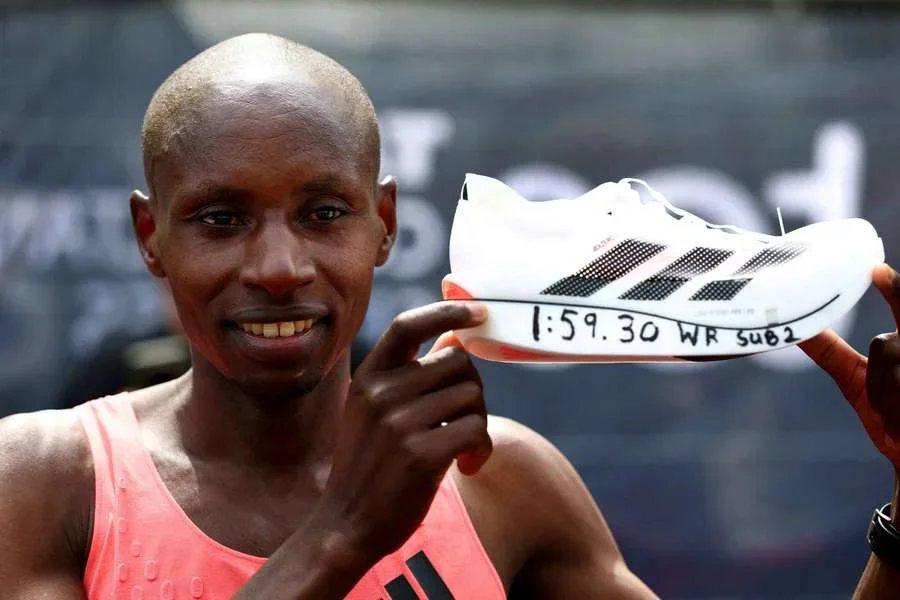
The mythical two-hour barrier was shattered on Sunday, April 26, at the London Marathon, a feat driven by advances in training and nutrition, but also by the technological boost from ultra-light carbon-plate shoes with foam midsoles.
These innovations have transformed long-distance running in recent years. With 18°C temperatures and no wind, London provided perfect conditions. Kenyan Sabastian Sawe, 31, crossed the finish line at Buckingham Palace in 1 hour, 59 minutes and 30 seconds, ahead of Ethiopia’s Yomif Kejelcha (1:59:41). Both runners beat the previous world record set by Kenyan Kelvin Kiptum (2:00:35) in Chicago in October 2023, who died in a car accident just four months after his landmark run.
Sawe and Kejelcha both wore Adidas shoes in London—the first pair to weigh under 100 grams (97 grams), with a 39 mm thick sole.
Improvements in training methods, recovery, and nutrition are undeniable. But what happened on Sunday likely wouldn’t be possible without the introduction in 2016 of thick-soled shoes equipped with carbon-fiber plates, which help athletes achieve previously unattainable times on asphalt. The carbon plate acts like a spring, reducing fatigue in long-distance races. Combined with foam, it optimizes cushioning and enhances runner comfort. Studies estimate a 4% gain in efficiency.
### A Regulated Innovation
After a series of personal bests in 2019 using so-called “magic shoes,” World Athletics revised its rules on their use. The governing body, initially overwhelmed by the phenomenon, set a maximum sole thickness of 40 mm in 2020 and banned more than one plate made of other materials (carbon, plastic, etc.).
“Athletics has been built on records broken in the 1950s and 1960s in middle-distance events. There were 30 per decade, then 10, then 5, and then fewer and fewer,” said Jean-Claude Vollmer, a French marathon training specialist, in comments to AFP. “The arrival of these carbon and foam shoes was a blessing for World Athletics. The financial stakes are so high that it’s impossible to turn back,” he added.
Can this technological evolution be compared to what swimming experienced with polyurethane swimsuits, banned in 2010 after a wave of records?
“I used to be reluctant because not everyone could afford this equipment. Now everyone can buy the same gear. But technology should not distort the sport to the point where it becomes a spectacle,” said Frédéric Fabiani, a marathon expert within the French Athletics Federation.
### Transparency
Fabiani, who focuses heavily on nutrition, examined Sawe’s carbohydrate intake in detail. “He consumed 115 grams of carbohydrates per hour. Not long ago, the target was 60–70 grams, sometimes we ventured up to 80–90 grams. This is the first time I’ve seen such a high intake,” he noted.
Sawe’s achievement—a relative unknown in the marathon just two years ago—has raised some questions, especially given numerous doping scandals in Kenya in recent years. The country has recorded 140 suspensions for doping since 2017, including Ruth Chepngetich, the current women’s marathon world record holder. “He won two major marathons…” (the sentence appears incomplete in the original, but the point about his rapid rise remains clear).
